


NEWS
Group Outing
October 2026
End of October we turn off our computers and headed for a nice afternoon out to get our creativity out. This year we went glass paining at Canvas Ateliers in Amsterdam, fuelled by coffee and cake.


Interview with Academic Positions
1 October 2026
Emilia Olsson spoke with Academic Positions about our work on atomic-scale materials design. The interview explores how modelling and simulations help us understand and harness defects and disorder to improve materials, with applications ranging from computer chips to batteries. It also highlights our collaborative environment between academia and industry, allowing us to connect fundamental research with societal challenges and impact. The full interview can be read here: Flawed by design: Using disorder to create better materials.

Vitriflow release
27 September 2026
Our latest publication in Computational Materials Science introduces Vitriflow, a framework for generating and analysing ensembles of amorphous structures. Combining calibrated simulations with structural characterisation and uncertainty analysis, Vitriflow helps assess how reliably these ensembles capture the features of disordered materials. We demonstrate the approach for silica, silicon nitride, and samaria. The accompanying open-source software is available on our Github page, enabling Vitriflow to be used and adapted by the wider research community.
The full paper can be read here: https://www.sciencedirect.com/science/article/pii/S0927025626006178
Explore Vitriflow here

New publication in Nanoscale Advances
7 August 2026

Our latest work in collaboration with Leiden University is published in Nanoscale Advances. During an extended research visit in the group, Lukas Hückmann (who is now off to start his postdoc at UC Santa Barbara) investigated the role of surface topology on the phase selectivity of titanium silicide. Using a systematic interface formation workflow, we could show that Si(100) surface topology acts as a nucleation template, enabling a unique growth mechanism for the undesired phase, explaining why at these junction we do not see the formation of the thermodynamic ground state.
The full paper can be read here: https://pubs.rsc.org/na/article/8/18/5256/1291241
Successful BSc defence
3 June 2026
Marsal Colitt Marull successfully defended his BSc thesis on Na incorporation into amorphous silicon nitride on the 3rd June. Marsal joined the group for his BSc project in February as the last part of his studies at Maastricht University. In the last 4 months, Marsal has been developing a novel sampling scheme for investigating initial sodiation in sodium ion battery conversion anodes, and concluded his project yesterday with a presentation to the group, showing off his impressive work.
Marsal is now off to continue his studies at the University of Cambridge, and we wish him all the best for the future!

WomenNetPhysics 2026
8 MAY 2026
Barsha Bhattacharjee and Emilia Olsson joined the organising team of the annual WomenNetPhysics conference which this year took place in Amsterdam. Together with a team from UvA, AMOLF, and NIKHEF, we hosted 150 attendance at Amsterdam Science Park for a day filled with inspiring talks and network events. WomenNetPhysics is the largest Dutch networking event to strengthen the position of women in physics.
Read more about the conference here and on the ARCNL website.
EMILIA OLSSON PROMOTED TO ASSOCIATE PROFESSOR
APRIL 2026
January 29, Emilia Olsson passed her promotion interview. As of 1st April 2026, she is now associate professor of condensed matter theory at the University of Amsterdam.
Deep Tech Day panel on translating research to impact
28 January 2026
January 28, Emilia Olsson participated in the panel discussion on the role of deep tech in academia as part of the University of Amsterdam's Deep Tech Day. The panel discussed key challenges in translating fundamental science to industrially viable products and real societal impact. The panel was chaired by Prof Renee van Amerongen of University of Amsterdam, and consisted apart from Emilia of Constantijn van Oranje-Nassau (Techleap), rector magnificus Peter-Paul Verbeek, and Renee Frissen (head of operations at AI Plan).
More information about the day can be found at Linkedin , ARCNL, and the DeepTech Day site.
PISACMS Summer School
August 2025
From the 25th to 29th August 2025, PhD student Robin Delhomme attended the PISACMS summer school hosted at the Campus Pierre et Marie Curie of the Sorbonne Université. The event allowed him to broaden his knowledge of atomistic simulation methods across the length and time scales, from quantum Monte Carlo to coarse-grained molecular dynamics.

Successful BSc Defence
July 2025
Tera Molenaar has successfully finished her BSc thesis on strain engineering of 2D materials as part of her Physics and Astronomy studies at UvA/VU. During her time in the group, Tera used density functional theory simulations to assess the effect of strain on the electronic and potassium storage properties of three important 2D materials – graphene, silicene, and phosphorene. During the summer, we are very happy that Tera will continue her work on strain engineering, deepening the investigation to defect tuning.
Tera's thesis can be found at https://scripties.uba.uva.nl/search?id=record_56519
Keynote talk KNCV CTC Symposium
14 April 2025
Emilia Olsson was invited to give the keynote talk for the 2025 KNCV Computational and Theoretical Chemistry (CTC) symposium at the University of Twente on the 14th April 2025. Her talk focused on atomic scale materials design and its applications beyond academia for next-generation technological solutions, highlighting her group's work on dual-use materials.

Invited talk Molecular Dynamics for Materials Science
7 April 2025
Emilia Olsson presented our innovative disorder- and interface modelling framework at the Molecular Dynamics for Materials Science conference at the Lorentz centre in Leiden, NL, highlighting our work on interface dynamics and the integration of density functional theory with molecular dynamics simulations.

Invited talk MATSUS Spring 2025
5 March 2025
Emilia Olsson gave an invited talk on interface modelling of complex electrochemical systems, coupling to experimental in operando techniques at the Materials for Sustainability conference in Sevilla Spain on March 5th 2025. Atomic scale modelling plays an important part in linking experimentally observed behaviour to atomic scale mechanisms, allowing for intelligent materials design. In her talk, she presented the Materials Theory and Modelling group’s modelling toolbox, and discussed the latest results from the group on tackling these challenges.

New publication and interview in Sustainable Energy&Fuels
January 2025
Our latest work on atomic scale materials defect engineering was published as part of the Emerging Investigators Series in Sustainable Energy & Fuels. In this work (which can be found here), we investigate the role of vacancy defects on dendrite formation in graphene-based alkali metal ion batteries as part of our ongoing work on sustainable materials design. As part of this issue, Emilia Olsson was also interviewed for the Royal Society of Chemistry Emerging Investigator series - read the interview here.
MMDTechHub grant
January 2025
Dr Emilia Olsson has together with Dr Sonja Pullen and Dr Bettina Baumgartner from the Van’t Hoff Institute for Molecular Sciences received a Molecular and Materials Design (MMD) Technology Hub grant for their project entitled Optimizing Porous Thin Films for Enhanced Charge Transfer in Solar Energy Conversion Applications. With this collaborative grant, we will build an integrated computational and synthetic design framework for thin film metal organic frameworks for use in solar energy conversion applications.
More information about the project can be found here and on the Institute of Physics News site here.
3 New PhD students join MTM group
November 2024
In autumn 2024, three new PhD students joined the Materials Theory and Modelling group. Thomas Nieboer and Robin Delhomme both started their PhDs in September, with Giona Mainardis joining in November. Thomas is exploring how we can tune the properties of two dimensional borides, carbides, and nitrides by using atomic scale materials design and interface engineering. Prior to joining ARCNL, Thomas completed his BSc and MSc in Physics at Rijksuniversiteit Groningen. Robin joins our TKI funded project “COATINGS” to investigate the effect of disorder and heteroatom incorporation in oxide coatings within the group’s application specific materials design theme. Prior to joining ARCNL, Robin completed his MSci in Physics at University College London, and a data analysis internship at BMW. Finally, Giona will work on our TKI funded project ARISTOTLE in collaboration with researchers at ASML and SKF. Prior to joining ARCNL, Giona completed a Master of Science in Physical Chemistry at the University of Copenhagen, Denmark, and a Bachelor of Science in Chemistry at the University of Turin, Italy.

MATSUS Fall 24 Symposium
November 2024
On November 12-15 2024, the Materials for Sustainable Development conference was organised in Lausanne, Switzerland. Emilia Olsson arranged together with Heather Au from Imperial College London, United Kingdom, a two-day symposium on materials design across the scales bringing together international computational and experimental experts. Speakers included Saiful Islam from the University of Oxford, Carla de Tomas from Imperial College London, Wei Yu from Tohuku University, Laura Lander from Kings College London, and Alexander Forse University of Cambridge. The full list of talks and abstracts can be found here.

TKI grant awarded
October 2024
Emilia Olsson has been awarded a TKI grant as part of Holland High Tech’s Semiconductor Manufacturing Equipment programme, together with project partners ASML and SKF. A third of the yearly global energy loss has been attributed to friction-induced processes, making the search and development of highly efficient and durable tribological coatings imperative. Significant research effort has been devoted to developing high performing coating materials with excellent friction properties, but the role of the interface between the tribological coating and its substrate is poorly understood. Gaining an atomic scale understanding of these interfaces will allow for the origin of weaknesses to be identified, and mitigation methods to be developed. ARISTOTLE (A Realistic Description of Tribological Interfaces) will provide funding for a 4-year PhD position, and allow us to tackle exactly these challenges.
CECAM FLAGSHIP WORKSHOP
18-21 June 2024
Emilia Olsson gave an invited talk titled “Towards heterogeneous interface modelling” at Centre Européen de Calcul Atomique et Moléculaire (CECAM) in Lausanne, Switzerland as part of the Electrochemical Interfaces in Energy Storage: Advances in Simulations, Methods and Models Flagship workshop.

SUCCESSFUL BSc DEFENCES
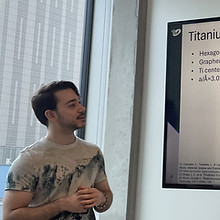
CHRISTIAN'S BSc THESIS DEFENCE
21 June 2024
Christian Mirone has successfully defended his BSc thesis as part of the University of Amsterdam and Vrije Universiteit Amsterdam Physics and Astronomy Bachelor degree. Christian used density functional theory to investigate a novel two-dimensional coating material, with several exciting findings. We wish Christian all the best in his future endeavors!
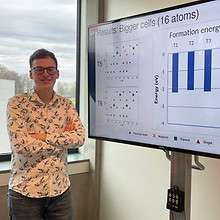
WESSEL'S BSc THESIS DEFENCE
20 April 2024
Wessel Beumer has successfully defended his BSc thesis where he developed a new code to generate interface structures. Wessel joined the group in January 2024 and spent 10 weeks developing a Rust based Python library named Crystacean based on the Restricted Random Structure Search interface modelling methodology developed by the group. Wessel will rejoin the group in the summer as an intern to make Crystacean publically available to the research community later in the year. We wish Wessel all the best in his future endeavors and look forward to the future work coming out of this thesis together!

AMY'S BSc THESIS DEFENCE
27 February 2024
Amy Oppong has successfully defended her BSc thesis on the effects of tensile and compressive stress in complex oxide materials. Amy joined the group in November 2023 as the final part of her BSc programme at UvA/VU, and has spent 10 weeks investigating how we can use stress and strain to alter ionic conductivity in complex oxides. We wish Amy all the best in her future endeavors!

SPECIAL SYMPOSIUM ON SUSTAINABLE MATERIALS RESEARCH
1 May 2024
Wednesday 1st May we organised a special ARCNL colloquium on sustainable materials research, with invited speakers from the United Kingdom. Dr Heather Au from Imperial College London gave a talk on Carbon Fibre Hosts for Sustainable Lithium-Sulfur Battery Electrodes, and Dr Maria Crespo from Queen Mary University of London presented her work on sodium-ion batteries and taking her research from materials development to operando characterisation. The day was then wrapped with research discussions, exploring how we can combine materials synthesis, device application, and materials modelling in an intelligent materials design framework for making technologies more sustainable from the atomic scale up.
New publication in Journal of Physical Chemistry Letters
18 January 2024
Together with collaborators from the University of Leiden we have elucidated the multifaceted role of hydrogen in amorphous silicon nitride in our latest publication “From Jekyll to Hyde and Beyond: Hydrogen’s Multifaceted Role in Passivation, H-Induced Breakdown, and Charging of Amorphous Silicon Nitride“. In semiconductor devices, hydrogen is typically considered as a panacea for defects, neutralizing dangling bonds and consequently purging the related defect states from the band gap. In amorphous silicon nitride, a material that is critical for electronic, optical, and mechanical applications hydrogen passivates both silicon and nitrogen dangling bonds. However, as we show in our paper, the story does not end there. By employing density functional theory calculations, we could unveil hydrogen’s multifaceted role in a-Si3N4. On the “Jekyll” side, hydrogen atoms are indeed restorative, healing coordination defects in a-Si3N4. However, “Hyde” emerges as hydrogen induces Si–N bond breaking, particularly in strained regions of the amorphous network. Beyond these dual roles, our study revealed an intricate balance between hydrogen defect centers and intrinsic charge traps that already exist in pristine a-Si3N4: the excess charges provided by the H atoms result in charging of the a-Si3N4 dielectric layer.

AMOLF SUSTAINABLE ENERGY MATERIALS COLLOQUIUM
20 November 2023
Emilia Olsson gave an invited talk entitled Computational Materials Design – Using atomic scale modelling to develop and optimise materials for next-generation energy technologies at the AMOLF Colloquium for Sustainable Energy Materials.
MATSUS FALL 2023
20th October 2023
Emilia Olsson was an invited speaker at the 2023 Materials for Sustainable Development Conference (MATSUS) Fall that took place in Torremolinos, Spain, 16-20 October. Contributing to the symposium Emerging Battery Technologies, Emilia presented the group's work on disordered carbon materials for Li, Na and K-ion battery technologies in her talk entitled Computational Materials Design - Probing Carbon Motifs for Next-generation Batteries.
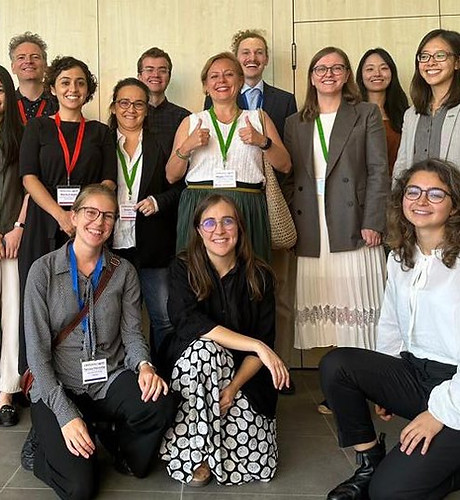
OPEN PhD POSITION
17 October 2023
We have an opening for a highly motivated PhD student in the Materials Theory and Modelling group at ARCNL. If you are interested in pursuing a PhD in computational materials physics and chemistry to design next-generation coating materials with a direct application focus - apply through our institutional website.
IUPAC|Chains 2023
22 August 2023
Emilia Olsson gave an invited talk on materials design of perovskite oxides at IUPAC|Chains 2023 in the Hague.


FROM MINERALS TO MATERIALS
27 June 2023
Emilia Olsson gave an invited talk at University College London on the 27th June 2023 at the From Minerals2Materials conference on “Materials Design – from fuel cells to semiconductors” in celebration of Professor Nora de Leeuw's 60th birthday.
VAN MARUM COLLOQUIUM
3 May 2023
Emilia Olsson gave a van Marum Colloquium at the University of Leiden on the topic of Understanding Surfaces and Interfaces from the Atomic Scale – Applications to Batteries and Semiconductors.
POSTER PRESENTATIONS AT NWO PHYSICS
6 April 2023
NWO Physics is the largest physics conference in the Netherlands and was organised 3-5 April. Barsha Bhattacharjee and Johanna Nemec both presented posters of their PhD work in the Materials Physics session on the 4th April. Barsha presented a poster on tuning of mechanical properties of transition metal nitrides, and Johanna on the exploration of different atomic-scale modelling methods on silica structures.


NWO PHYSICS
6 April 2023
We organised a focus session on Computational Materials Design at NWO Physics 2023 in Veldhoven. Computational materials design is a vital tool in materials physics research and is of ever growing importance. Combining state of the art computational materials modeling and characterization, with experimental testing and validation allows for new materials to be designed for specific applications. Directly probing and predicting the correlation between the atomic scale structure and a material’s properties gives us powerful tools with which to design next generation technologies, advancing our society. Computational materials design is typically an interplay between, physics, chemistry, biology, engineering, and materials science where the understanding of the underlying physical processes are becoming increasingly important to accurately predict and understand material properties and behavior. In this focus session, we brought together the Dutch computational materials modelling community focusing on density functional theory (DFT), molecular dynamics (MD), and multiscale modelling with talks on Taming the defects in halide perovskites: insights from multiscale simulations by Shuxia Tao from TU/e, In silico defect engineering to facilitate the design of functional materials by Jonathon Cottom from Leiden University, Modelling of Complex Energy Materials with Machine Learning by Nong Artrith from Utrecht University, and Multiscale materials design and modelling for electrochemical energy devices by Qiong Cai from the University of Surrey.
TWO BOOK CHAPTERS PUBLISHED
23 January 2023
We have contributed chapters to two books on sodium-ion batteries. The first book chapter details recent Computational Studies on Na-Ion Electrode Materials in Sodium‐Ion Batteries: Materials, Characterization, and Technology, and the second focuses on Atomistic Modeling and Analysis of Electrolyte Properties for Sodium-Ion Batteries in Handbook of Sodium-Ion Batteries.

NEW RESEARCH ARTICLE PUBLISHED IN SMALL
27 August 2022
Our latest work on carbon anodes for alkali ion battery materials has been published in Small. In this work, we explore the binding and breakdown of ethylene carbonate on hard carbon showing how the surface termination, roughness, and defects influence the initial liquid solid interaction and facilitate breakdown.

REVIEW ARTICLE PUBLISHED IN ADVANCED ENERGY MATERIALS
17 May 2022
Computational materials design has greatly accelerated the alkali-ion battery field. Publishing in Advanced Energy Material, we present a review article that shows that computational modeling is an integral part of the battery research environment and a powerful tool to support experimental studies, to unravel important atomic scale properties and features to gain fundamental understanding of properties and mechanisms that are challenging to obtain solely from experimental analysis and measurements.
WISE FELLOWSHIP
15 April 2022
Emilia Olsson has received a Women in Science Excel (WISE) grant amounting to 250.000 euros from the Dutch Research Council (NWO). With her WISE Fellowship, Olsson and her team will conduct atomic-scale modeling of solid-state materials to explore and design materials for EUV lithography. Directly probing the materials properties and mechanisms that lead to enhanced and limited performance is challenging. The group will develop a computational framework to probe the effect of initial surface structure and deposition on interface formation. These models will allow degradation pathways to be explored at different interface systems, permitting for mitigation and optimisation.

NEW COLLABORATIVE EXPERIMENTAL AND COMPUTATIONAL PAPER ON MICRO-MESOPOROUS HARD CARBONS AS SODIUM-ION BATTERY ANODES
28 November 2021
Continuing the collaboration sodium ion battery carbon anodes, our latest paper is now available in Advanced Materials and Interfaces investigating hard carbons with tailored bimodal porosities as sodium-ion anodes. We show that the nature of the innermost solid electrolyte interphase (SEI) sub-layer controls the performance. F-containing salts enable a stable SEI, yet enhanced electrolyte decomposition seems unavoidable in carbonate-based solvents compared to ether-based systems.

MOVE TO ARCNL AND UVA
1 September 2021
On the 1st September, Emilia Olsson started as a group leader at the Advanced Research Center for Nanolithography and a tenure track assistant professor at the University of Amsterdam. Starting up our new group called Materials Theory and Modeling, we will focus on atomic-scale modeling of solid-state materials and materials discovery. For novel lithography technologies, materials are pushed to extreme limits, which requires atomic level understanding in order to predict, comprehend, and control their properties.
Using cutting-edge density functional theory (DFT) and molecular dynamics (MD) modeling techniques, the group will conduct simulations of bulk, surface, thin-films, and interface systems to explore and design novel materials for EUV lithography. These atomic-scale insights will enable novel candidate materials, and breakdown/performance limiting mechanisms in current materials, to be identified, leading to the development of improved materials for EUV lithography.
MRS SPRING MEETING 2021
17 April 2021
Emilia Olsson gave one pre-recorded and one live contributed talk at the virtual Materials Research Society Spring Meeting 2021.


TWO NEW PUBLICATIONS
30th September 2020
Our two latest papers on hard carbon anodes for sodium ion batteries have been published in Energy and Environmental Science and ACS Applied Energy Materials.


CONFERENCE PRESENTATION
25th July 2019
Emilia Olsson is giving a talk on Carbon-Based Anode Materials for Alkali Metal Ion Batteries–Atomic Scale Studies of Defects, Functional Groups, and Electrolytes and Their Impact on Metal Storage and Diffusion at the Electrochemical Conference on Energy and the Environment in Glasgow, Scotland.
VISITING RESEARCHER
March 2019
Emilia is joining the Department of Chemical Engineering at Imperial College London as a visiting researcher in the Titirici group.